Memory
Memory is shaped by how, when, and in what context information is encoded and retrieved. Spacing, retrieval practice, interleaving, and elaboration are the four evidence-based levers.
Reference: https://doi.org/10.1017/CBO9781139547369.013
Memory is shaped by how, when, and in what context information is encoded and retrieved. Four decades of cognitive science — from Ebbinghaus’s forgetting curve through Bjork’s desirable difficulties framework to Karpicke and Roediger’s retrieval practice studies — converge on a counterintuitive design implication: the conditions that feel most productive during learning (massed practice, re-reading, blocked repetition) are often the least effective for long-term retention.
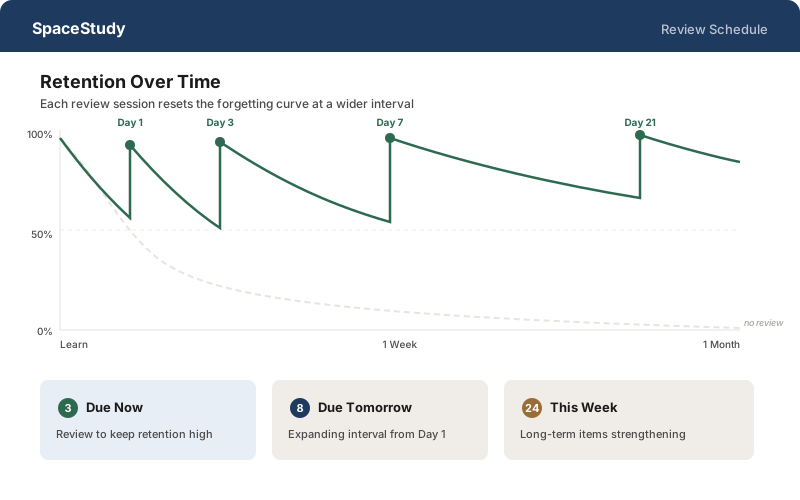
Space practice sessions across time
Ebbinghaus (1885) first documented the forgetting curve. Cepeda et al. (2006) confirmed across 254 studies that distributed practice produces stronger retention than massed practice across virtually every domain and age group. Each review resets the forgetting curve before the memory decays too far, producing durable long-term retention with less total study time than cramming. Duolingo’s half-life regression model and Anki’s SM-2 algorithm are production implementations of this principle, though the former rarely produces fluent second language speakers, which is a separate problem.
Require learners to actively retrieve information rather than passively review it
Karpicke and Roediger (2008) demonstrated that retrieval practice produces roughly 50% better long-term retention than re-study, even when re-study gets more total time on material. The mechanism: retrieving a memory strengthens the retrieval route itself, not just the stored information. This flashcard interface forces the learner to type an answer before revealing the correct one: retrieval practice rather than passive recognition.

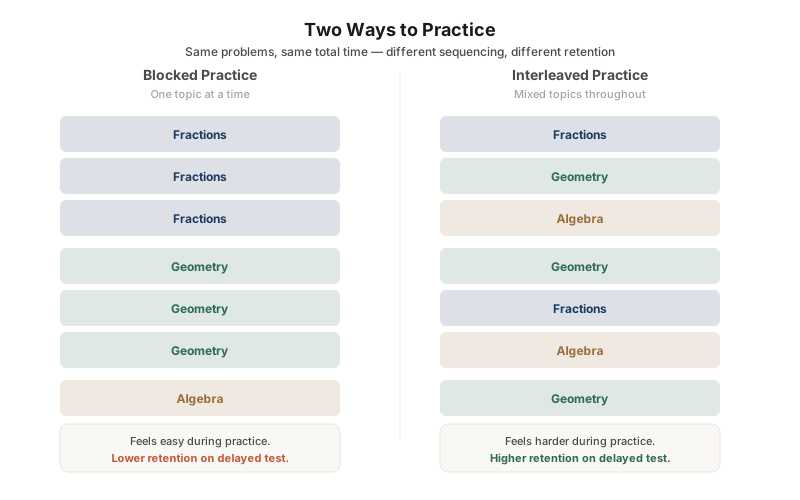
Interleave different problem types during practice sessions
Rohrer and Taylor (2007) showed that interleaved math practice produced 43% better test performance than blocked practice — despite students rating blocked practice as more effective. The benefit: interleaving forces learners to discriminate between problem types, not just execute a procedure they already know is coming. The session on the right mixes fractions, geometry, and algebra. It feels harder during practice, and that difficulty is the point.
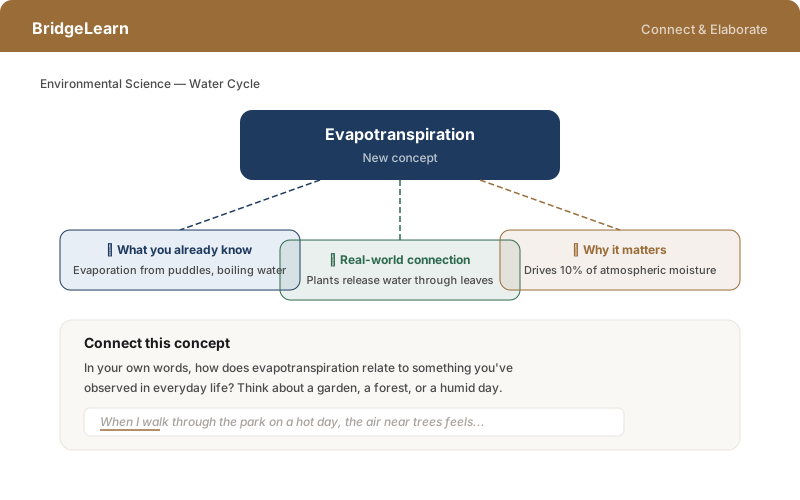
Prompt learners to connect new information to what they already know
Elaborative encoding — building meaningful connections rather than rote memorization — produces deeper, more retrievable memory traces (Craik and Lockhart, 1972). This science lesson asks learners to link a new concept to prior knowledge, real-world observations, and significance. The prompt structure matters: “How does this relate to what you already know about X?” activates elaboration. “Remember this” does not.
Boundary conditions
Spacing requires initial encoding. Spacing reviews of material the learner never encoded produces nothing to retrieve. Ensure a minimum encoding threshold before introducing spacing schedules.
Retrieval practice requires retrievable content. Karpicke’s studies used material learners had already studied at least once. Asking learners to retrieve information they have never encountered is just guessing. Pair with initial instruction.
Interleaving hurts when problem types are not yet learned. Rohrer’s results apply to practice after learners have been introduced to each problem type. Interleaving during initial instruction, before any category knowledge exists, produces confusion rather than discrimination. Introduce categories first, then interleave.
Expertise moderates the benefit. Advanced learners who already have strong retrieval routes gain less from forced retrieval practice or heavy spacing schedules. The marginal benefit decreases as the learner’s existing schema strengthens (Kalyuga et al., 2003). See the Expertise Reversal pattern.