Transfer
Transfer is the goal of all instruction, and the hardest outcome to design for. The methods that feel most efficient (blocked practice, isolated drills) are often the worst for it.
Reference: https://doi.org/10.4324/9781315113210
Transfer is the entire point of my career. Every other pattern on this site (scaffolding, memory, cognitive load management) exists so that learners can use what they learned in situations they have not encountered before. But transfer is also what instruction most consistently fails to produce. Barnett and Ceci (2002) reviewed the experimental literature and found far transfer to be rare under controlled conditions. Gick and Holyoak (1983) showed that after studying a solution strategy in a story, most students failed to apply it to an analogous problem unless explicitly told the two were related. The knowledge was there. The connection was not.
Van Merriënboer calls the core design tension the “transfer paradox”: instructional methods most efficient for reaching specific objectives (blocked practice, isolated drills, one concept at a time) are often the worst for producing transfer (Helsdingen, van Gog, & van Merriënboer, 2011). Blocked practice builds specific knowledge that only works under the conditions it was trained in. Transfer requires generalized schemas that adapt to novel situations. Building those schemas feels less productive during training. Learners rate blocked practice as more effective even when interleaved practice produces better test outcomes. The same paradox shows up in the Memory pattern’s interleaving research, where Rohrer and Taylor’s students preferred the method that performed 43% worse on the delayed test.
Vary practice contexts to force schema abstraction
Paas and van Merriënboer (1994) compared high-variability and low-variability practice sequences for geometry. Learners who practiced problems that varied across dimensions (context, presentation, surface features) transferred better to novel problems than those who practiced blocked sequences of similar problems. The blocked group felt more confident during training. They were wrong. Variation forces learners to discriminate: which features of a problem actually determine the solution, and which are surface noise?
Side Note: this is why I believe “production”-based learning beats curriculum-based learning for building technical skills. Every real project arrives with different constraints, different stakeholders, different failure modes. You cannot block-practice your way through a production codebase. There has to be stakes in the game.
This Actively Learn lesson asks students to practice close reading across a diverse range of texts. The variation in content is the point, not a distraction.

Use whole tasks from the start
Van Merriënboer and Kirschner’s (2018) 4C/ID model starts from a whole-task premise: learners work on complete, meaningful tasks from day one, with support that fades as competence grows. The alternative, teaching constituent skills in isolation and hoping learners assemble them later, produces fragmentation. Each skill works individually but the coordination between them never develops. Playing piano with two hands is not the sum of playing with the left hand and the right hand.
This Coursera lesson frames projects around a real job scenario. The learner does what a working data analyst would do, not isolated spreadsheet drills.

This Serious SQL lesson focuses on key workflow steps relevant for workplace performance. The whole analytical task, not syntax in isolation.

Prompt learners to recognize structural similarities
Far transfer runs on analogical reasoning: recognizing that a new problem shares structural features with one you already solved, despite looking different on the surface. Gick and Holyoak (1983) are the foundational study. Students who studied two analogous stories and were prompted to compare them extracted the shared principle and transferred it. Without the comparison prompt, transfer was rare. Gentner, Loewenstein, and Thompson (2003) confirmed this in negotiation training: learners who explicitly compared two cases outperformed those who studied the cases separately.
Do not provide diverse examples and hope learners notice the connections. Build comparison into the task. “How is this problem like the one you solved yesterday?” is a more powerful question than most instructors realize.
This Coursera lesson uses open-ended prompts to elicit connections to learners’ personal experiences.
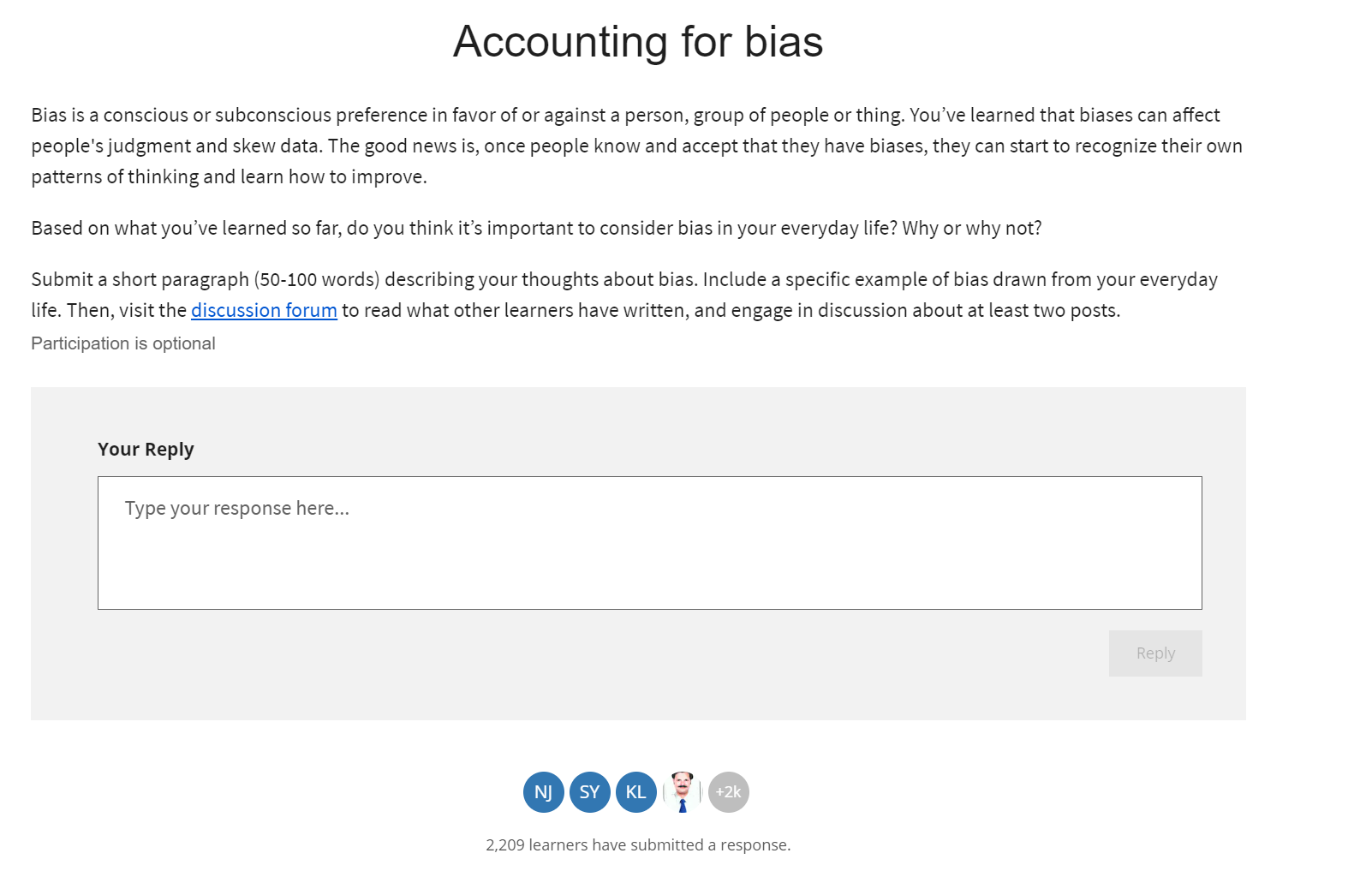
DataCamp encourages learners to make connections across learning contexts.

Make expert thinking visible
Experts do not just arrive at correct answers. They notice different features, apply different strategies, and monitor their progress differently than novices. This invisible expertise is what needs to transfer, not just the procedures. Process-oriented worked examples that show not just what the expert did but why help learners build cognitive strategies that generalize across problems. See the Worked Example pattern.

Situational judgement tests can assess whether transfer actually happened, by presenting realistic scenarios that require applying principles in context rather than recalling them in isolation.

Boundary conditions
Far transfer is rare and hard to measure. Barnett and Ceci (2002) warned that “near” versus “far” depends on which dimensions you measure: content, context, temporal distance, functional distance. Day and Goldstone (2012) found that the hardest part is not applying knowledge but recognizing that transfer is possible in the first place. Design for recognition, not just application.
Transfer requires prior knowledge. You cannot transfer what you have not encoded. The Memory pattern’s spacing and retrieval practice build the encoding strength that transfer depends on. Jumping to transfer activities before initial learning has occurred is just guessing with extra steps.
Motivation is underrated. Perkins and Salomon (2012) argued that transfer requires not just ability but inclination, the disposition to look for connections across contexts. James (2012) studied transfer motivation in academic writing students and found it rare. If learners do not see why transferring matters, they will not try. See the Control and Motivation pattern.
Learning conditions must match transfer conditions. Morris, Bransford, and Franks (1977) showed that memory performance depends on the match between processing during learning and retrieval, not on “depth” per se. Larsen-Freeman (2013) connects this to a practical failure: language drills produce accurate pattern reproduction in class but fail in authentic conversation because the gap between learning and retrieval conditions is too wide. Knowledge stays inert.